
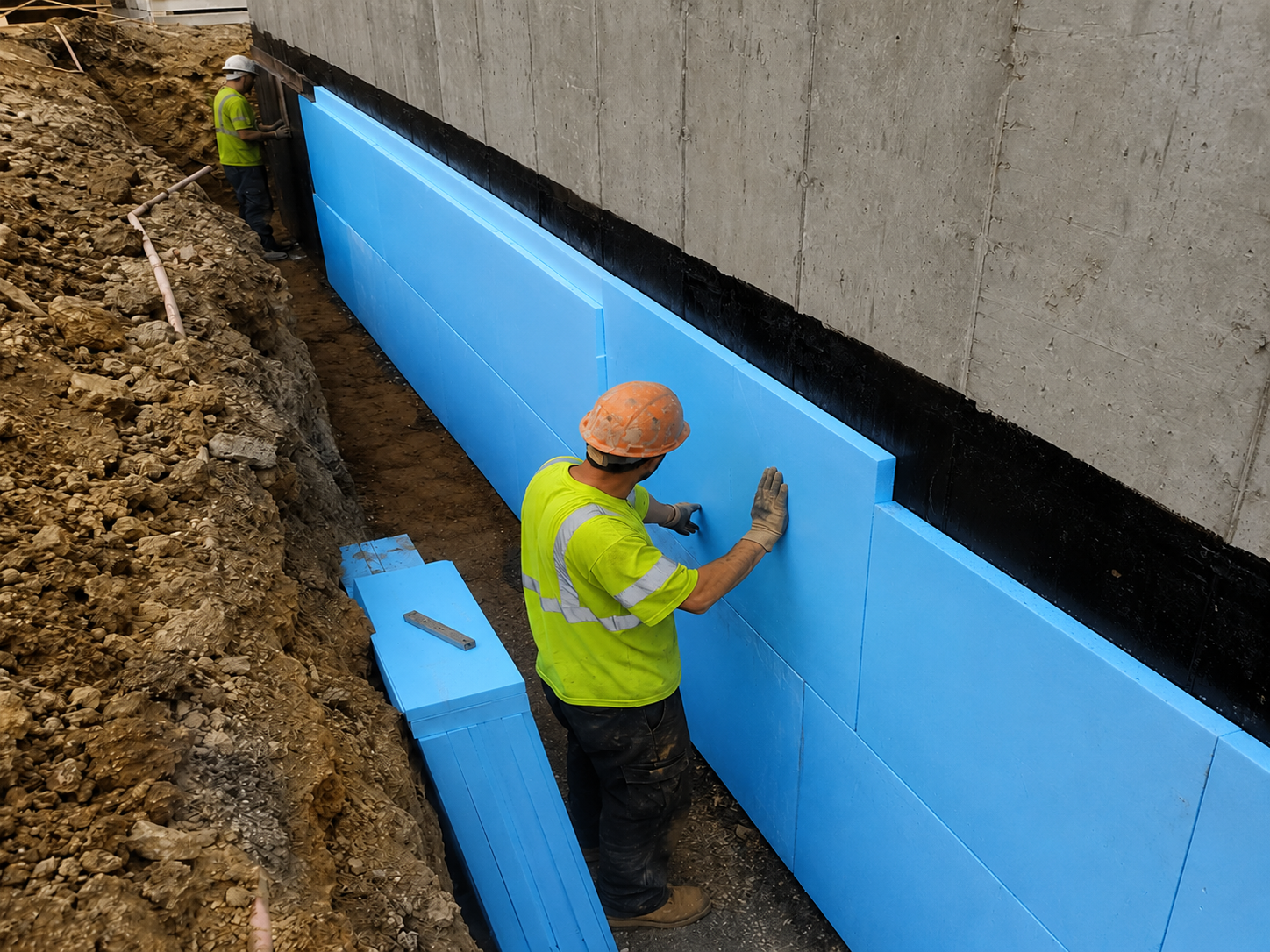
Quick answer: Thickness controls thermal performance and is driven by the required R-value and available cavity depth. Density controls compressive strength and is driven by the load the board must carry. They are separate decisions and should be specified separately.
Thickness or Density: Which Comes First
Buyers often treat thickness and density as one combined choice. In practice they answer two different questions, and mixing them up leads to boards that are thermally adequate but structurally wrong, or the reverse.
- Thickness answers: how much thermal resistance do I need, and how deep is the space I can fill?
- Density answers: what load will this board carry without deforming?
Fix the application and the load first, then select density. Select thickness from the thermal target and the cavity depth available. Confirm both against the system design before ordering.
Matching Density to the Load
Density is the practical proxy for compressive strength. Where a board is only providing thermal separation inside a protected cavity, a lower density is normally sufficient. Where the board carries a screed, a tile finish or foot traffic, the requirement changes.
- Wall cavity and behind-cladding use - the board is not load bearing; the fixing system carries the load.
- Underfloor and under-screed use - the board must resist compression from the floor build-up and any imposed load.
- Roof and inverted roof use - dense enough to resist the load above it and stable under moisture exposure.
- Wet-area backer board - has to hold tile and adhesive without deflection, in addition to thermal duty.
Always specify the compressive strength requirement rather than the density alone where the board is structural. Density is the manufacturing input; compressive strength is the performance you actually need.
Matching Thickness to the Application
Thickness selection is a balance between the thermal target and the space available. In retrofit work the cavity depth is usually the limiting factor; in new build the thermal target leads.
- Retrofit and renovation - cavity depth limits thickness; use a thinner board with a lower thermal conductivity to reach the target.
- Underfloor heating - thickness must be enough to direct heat upward without raising the finished floor level beyond the design.
- External wall systems - thickness follows the required overall wall U-value and the fixing and render system.
- Wet-area backer board - thickness is chosen for rigidity and screw-holding rather than thermal duty alone.
When the thermal target and the available depth conflict, that conflict should be resolved at design stage. Ordering a compromise board without recalculating usually means the assembly misses its target.
Writing the Specification Correctly
Ambiguous specifications are the main cause of wrong-board deliveries. State each dimension explicitly in the purchase order.
- Board type - XPS, graphite EPS or composite backer
- Thickness in millimetres
- Density or minimum compressive strength, and at what deformation
- Length and width, plus tolerance
- Edge profile - square, shiplap or tongue and groove
- Surface - smooth, embossed, mesh-reinforced or coated
- Application and the standard the assembly must meet
Where a project has an approved specification, attach it. Where it does not, describe the application and the load, and let the supplier propose a board that meets it.
Buyer Checklist
- Thermal target and cavity depth confirmed
- Compressive strength requirement stated, not just density
- Thickness, length and width specified with tolerances
- Edge profile and surface treatment defined
- Application and imposed load described
- Assembly standard or approved specification attached
- Compatibility with adjacent materials checked
Buyer FAQ
Can I compare boards by density alone?
No. Density is a manufacturing input. For load-bearing use, specify minimum compressive strength at a stated deformation.
Is thicker always better thermally?
Within the same board type and conductivity, yes. But a thinner board of lower conductivity can match a thicker board, which matters in depth-limited retrofits.
Which density is right for underfloor heating?
It depends on the floor build-up and imposed load rather than the heating itself. Specify the load and confirm the compressive strength required by the design.
Do I need the same thickness throughout a project?
Not necessarily. Different elevations, floor build-ups and wall systems can require different thicknesses within one project.
What if my specification differs from a standard board?
Custom thickness, density and dimensions are usually available. Raise them at enquiry stage, as custom specifications change the minimum order quantity.
Related Baozhinuan Products
Explore Baozhinuan XPS insulation boards, graphite EPS insulation and waterproof tile backer boards for commercial sourcing and project applications.
Request a Specification Review
Send the application, required performance, board dimensions, quantity, customization needs, destination and delivery schedule. Baozhinuan will review the details before quotation.
Submit Your RFQProject requirements should be verified against current official standards, product documentation and local regulations.